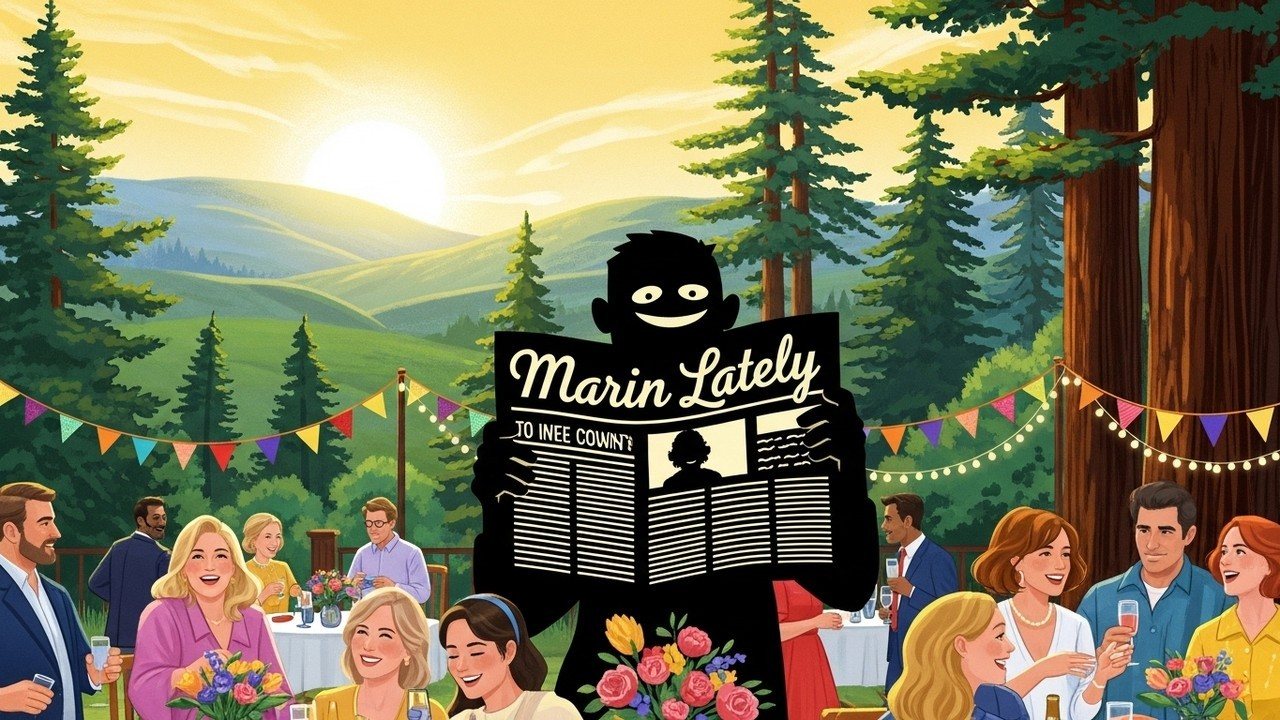
Marin County satire is not merely a punchline about sun-kissed hills and enviable weather; it is a social barometer that exposes quiet fractures beneath a glossy veneer. Marin County satire thrives where insider status meets public curiosity, turning the Bay Area’s most prized suburb into a theater for wit, skepticism, and uneasy self-reflection. In this piece, we explore Marin Lately as a diagnostic tool—both a mirror and a magnifying glass—revealing how satire can illuminate power, privilege, and the real people behind the headlines. By tracing its origins, tone, and reception, we can understand why the publication matters beyond merely making readers laugh. This is not about tearing down the region; it is about analyzing how a vibrant civic conversation evolves when humor becomes a method of accountability. The phenomenon invites broader questions about media, identity, and the delicate balance between celebration and critique in a community famous for its paradoxes.
The Marin Lately Phenomenon: Satire in a Coastal Power Center
From cliffside mansions to sunlit cyber cafes, the Bay Area’s jewel of Marin County invites a sharper look at the social fabric that sustains it. This is not mere wink-wink humor; it is a deliberate probe into how prestige, proximity, and public life interact in a place where every yard sign and local feature can become a talking point.
Social Mirrors in a Wealthy Landscape
Marin Lately uses insider humor to spotlight how prestige shapes conversation, from glossy Instagram reels to backyard barbecues. The satire relies on shared knowledge—references to local landmarks, to The Times, and to the subtle indicators of cultural belonging—to land its punch while inviting readers to reflect rather than alienate. In this setting, humor becomes a lens that reveals patterns of clustering, language, and aspiration, turning everyday scenes into a stage for civic commentary.
By turning etiquette into punchlines, the publication asks readers to balance affection for the region with a critical eye toward its blind spots. The anonymity of the author adds tension: is the mystery a flourish or a flaw? Either way, the work functions as a venue for discourse about diversity, equity, and the delicate negotiation of pride and humility in a place celebrated for its innovation and its contradictions.
The Craft of Marin Lately: Voice, Anonymous Authorship, and Public Appetite
Marin Lately blends sharp observations with affectionate irony, borrowing a format familiar to national satire while anchoring it in distinctive local detail. The choice to keep the author unseen becomes part of the piece’s aesthetic, a playful constraint that foregrounds ideas over personalities. Readers recognize the map of neighborhoods and micro-communities, which makes the humor feel intimate and, at the same time, widely legible.
Beyond jokes, the publication signals a robust appetite for dialogue about representation and inclusion. It tests boundaries between entertainment and critique, aiming to challenge inequities without souring community ties. If the work achieves a balance between wit and responsibility, it becomes a model for how regional satire can contribute to broader conversations about power, culture, and belonging.
Satire as Social Mirror
Humor distills complex social dynamics into approachable moments, turning private chatter into public discourse that can illuminate structural tensions. In a county where status and place are frequently discussed aloud, humor can reveal blind spots around economic clustering, political homogeneity, and the ease with which identities are curated. The aim is not to wound but to prompt reflection, offering a cautious nudge toward greater empathy and critical thinking.
Humor as a Tool for Civic Insight
Satire translates dense social dynamics into relatable scenes, and the result is a form of civic examination that respects nuance while still offering a provocative prompt to reexamine assumptions. The approach values context and local knowledge, inviting readers to connect the dots between micro-events and macro-trends without losing sight of individual dignity.
By leaning on local references and shared experiences, the satire builds trust with a committed audience who recognizes the stakes. It also raises questions about access: who gets to tell the story, who is targeted, and how boundaries are drawn. In a region famed for openness, humor can operate as a public audit, inviting ongoing dialogue about inclusion and accountability.
Audience Reception, Online Platforms, and the Public Square
Marin Lately thrives on social platforms that turn everyday conversations into data points for feedback, correction, and celebration. Reactions flow quickly, revealing how readers negotiate legitimacy and belonging in a digital public sphere. The strength lies in specificity: local jokes land most strongly with insiders, yet they often illuminate broader social tensions that resonate beyond Marin County.
Platform dynamics, however, can complicate reception. Anonymity may sharpen critique but also blur responsibility. The piece thus becomes a case study in digital civility and editorial ethics, exploring how humor in the public square can spark constructive debate while safeguarding reputations. In sum, the phenomenon offers a microcosm of how communities test ideas and shape norms through laughter.
- 01
- 02
- 03
- 04
Behind the Mask: The Mystery of Marin Lately’s Author
The mystique around the author sustains intrigue that extends beyond individual posts. Anonymity invites readers to evaluate content on merit, not personality, and mirrors long-standing traditions in investigative satire where the voice serves as conduit for collective critique rather than a single author’s persona.
Still, mystery carries risks. If the writer remains hidden for too long, questions about transparency and accountability may dampen trust. The balance between anonymity and clarity is a live test for the publication, offering a lens on how communities navigate fame, influence, and responsibility without sacrificing the play and curiosity that fuel public discourse.
A Public Whodunit and its Cultural Purpose
The unknown author becomes a provocative device that compels readers to engage with ideas rather than personality. It democratizes interpretation, inviting diverse perspectives to interpret the satire’s intent and impact. The risk is that the spark of curiosity may fade if readers cannot anchor a clear ethical frame around the work.
In this sense, the mystery functions as a social experiment: it tests whether humor can still drive accountability when the creator’s identity remains intentionally elusive. The result is a dynamic laboratory for examining power, privilege, and the boundaries of critique within a tight-knit community.
Historical and Literary Echoes: The Onion, Portlandia, Bridgerton
Comparisons to The Onion and Portlandia anchor Marin Lately within a recognized lineage of regional satire that blends affection with audacity. Bridgerton-inspired storytelling—where whispers shape the social map—gives the work narrative momentum and a sense of courtly intrigue that keeps readers turning pages of the local calendar.
This synthesis signals a broader cultural trend: local humor adopting cinematic and literary structures to shape memory, rumor, and public imagination. The result is a satire that feels both timeless and timely, a mirror that refracts how a community negotiates power, identity, and belonging in an era of rapid change.
Key Takeaways
Satire as a Civic Instrument
Marin County satire demonstrates that humor can function as public service when directed at systems rather than individuals, fostering dialogue that advances understanding and accountability.
The piece also reminds readers that wit is a social practice requiring sensitivity, context, and boundaries to avoid alienation while still challenging inequities and blind spots.
The Value of Mystery and Local Authorship
The anonymous author model can sharpen focus on ideas, encouraging readers to judge content on merit rather than personality or branding.
Ultimately, the enduring appeal lies in a shared cultural language—the jokes, landmarks, and loyalties that bind a region—through which communities test conformity and critical voice, shaping a more informed public.
|
Aspect |
Summary |
|
Subject |
Satirical examination of Marin County life through Marin Lately |
|
Format |
HTML article with five main sections, each containing two sub-sections |
|
Keyphrase |
Marin County satire |
|
Audience |
Bay Area residents, satire enthusiasts, readers of local journalism |
|
Distribution |
Cross-posted on social platforms with SEO optimization |
|
Takeaway |
Humor as a device for accountability and reflection in a prosperous community |
From our network :
- Mastering Error Handling in Python Programming
- MiniMax AI Models Rival OpenAI: New Text Image and Audio Capabilities
- PostgreSQL Connection Refused: Troubleshooting Connection Issues on Ubuntu
- Agnikul Successfully Launches SOrTeD and Achieves Milestones in Indian Space Sector
- Apollo 9 Mission Details: A Comprehensive Overview of the Historic Flight
- Understanding Relative and Absolute Motion
- 01
- 02
- 03
- 04
- 05
- 06
- 07
- 08
0 Comments