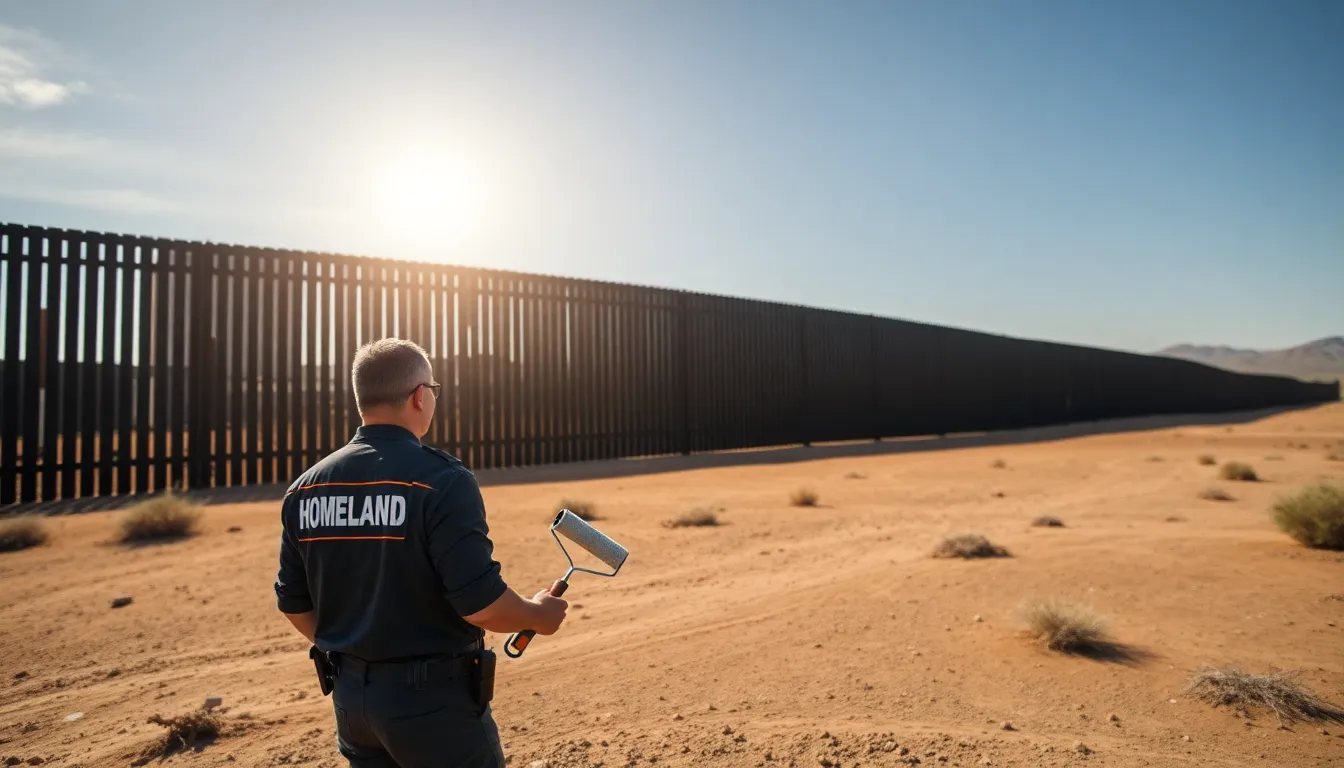
The concept of a formidable border wall has long been a cornerstone of immigration policy discussions, and now, a novel strategy is emerging to enhance its effectiveness: painting the entire southern border wall black. This initiative, driven by President Trump and championed by Homeland Security Secretary Kristi Noem, aims to leverage the physics of heat absorption to deter illegal crossings. By turning the wall into a more formidable obstacle through increased surface temperature, the administration seeks to discourage individuals from attempting to scale it. This innovative approach, while unconventional, highlights a commitment to exploring diverse methods for border security, integrating environmental factors into the physical landscape of defense. The strategy underscores a proactive stance in managing border challenges, seeking to create a more imposing and effective barrier.
Secretary Noem’s announcement during a visit to the New Mexico border segment shed light on the rationale, explaining that the black paint will intensify the heat absorbed by the wall, making it significantly hotter and thus harder to climb. This tactic, directly requested by the President, is intended to capitalize on the high temperatures already prevalent in the region. Furthermore, the paint serves a practical purpose by helping to prevent rust, thereby contributing to the wall’s structural integrity. As the administration continues to prioritize the completion of the wall, allocating substantial funds for its expansion, this thermal enhancement strategy represents a unique addition to the ongoing efforts to secure the nation’s borders.
The Black Border Wall: A Strategic Reimagining of Southern Border Security
In a bold and unconventional move, the Department of Homeland Security (DHS) is set to implement a striking new strategy to bolster border security: painting the entire southern border wall black. This initiative, championed by President Trump and spearheaded by Secretary Kristi Noem, aims to leverage the physical properties of color to create a more formidable deterrent against illegal immigration. Secretary Noem, during a visit to a segment of the wall in New Mexico, articulated the rationale behind this decision, highlighting how the intensified heat absorbed by the black surface is expected to make scaling the barrier significantly more challenging. This represents a novel approach, moving beyond traditional structural enhancements to incorporate environmental factors into the security paradigm.
The Heat is On: How Black Paint Enhances Deterrence
The core concept behind painting the border wall black is rooted in basic physics: darker colors absorb more solar radiation, leading to a substantial increase in surface temperature. This elevated heat is intended to act as a passive deterrent, making the physical act of climbing the wall an uncomfortable and potentially hazardous undertaking. The idea is that the increased heat will discourage migrants from attempting to scale the wall, thereby reducing unauthorized crossings.
Leveraging Thermal Properties for Security
Secretary Noem emphasized that this strategy is a direct directive from President Trump, who recognized the potential of using ambient heat to augment the wall’s effectiveness. The understanding is that the desert environment, already characterized by high temperatures, will amplify the effect of the black paint. This creates a more challenging and less inviting environment for those seeking to breach the border, adding a new layer of complexity to their attempts.
Beyond Climbing: Addressing Structural Integrity
Beyond its intended deterrent effect, U.S. Border Patrol Chief Mike Banks noted an additional, practical benefit of the black paint: its potential to combat rust. This dual-purpose application suggests a more holistic approach to wall maintenance and security, ensuring the structure remains robust while simultaneously serving its primary deterrent function. The long-term implications for the upkeep and longevity of the border infrastructure are considerable.
A New Era of Border Wall Construction and Funding
The implementation of the black paint strategy coincides with a significant push to complete the border wall, a project that has been a cornerstone of the Trump administration’s immigration policy. Despite shifts in focus towards interior enforcement and mass deportations during his second term, the commitment to physical barriers remains strong. Congress has allocated substantial funding, approximately $46 billion, to finalize the wall’s construction, signaling a continued investment in this security measure.
Accelerated Construction Pace
Secretary Noem highlighted the accelerated pace of construction, with approximately half a mile of barrier being erected daily. This increased efficiency in building the wall underscores the administration’s determination to achieve its objectives. The varying topography and geographical features along the extensive U.S.-Mexico border mean that the wall’s design and appearance will naturally adapt to the local landscape.
Innovations in Border Infrastructure
In addition to the conventional wall segments, DHS is also exploring and developing “water-borne infrastructure.” This indicates a broader strategy that encompasses not only land-based barriers but also measures to secure areas along waterways, such as the Rio Grande River in Texas, which constitutes a significant portion of the border. This multifaceted approach aims to create a comprehensive security network.
- 01
- 02
- 03
- 04
Contrasting Trends: Wall Completion Amidst Declining Crossings
Interestingly, the intensified efforts to complete the border wall are occurring at a time when the number of individuals attempting to cross the border illegally has notably decreased. This juxtaposition raises questions about the proportionality of resources allocated to wall construction versus other potential security strategies. However, the administration maintains that the wall remains a critical component of a comprehensive border security strategy.
The Evolving Landscape of Immigration Policy
The administration’s focus on completing the wall, even as illegal crossings decline, reflects a consistent adherence to its core immigration platform. While policy priorities may shift, the physical manifestation of border security through the wall continues to be a central theme. The allocation of significant funds underscores the long-term vision for border reinforcement.
Strategic Considerations and Future Implications
The decision to paint the wall black represents a creative, albeit unconventional, attempt to maximize the effectiveness of existing infrastructure. It highlights a willingness to explore innovative solutions in border security. The success of this strategy will likely be measured by its impact on deterring illegal crossings and its overall cost-effectiveness compared to other security measures.
The Final Solution: A Deep Dive into the Black Wall Strategy
The black border wall initiative is more than just a cosmetic change; it’s a strategic enhancement designed to leverage environmental factors for border security. By increasing the wall’s surface temperature, the DHS, under President Trump’s direction, aims to create a more potent deterrent against illegal immigration. This innovative approach, coupled with accelerated construction and complementary water-borne infrastructure, signifies a robust commitment to fortifying the southern border. While the effectiveness of such measures in the long run remains to be seen, the strategy underscores a proactive and adaptive approach to the complex challenges of border security, ensuring a more formidable and challenging barrier for potential crossers.
|
Aspect of Strategy |
Description |
|
Primary Goal |
Deter illegal immigration by enhancing the border wall’s effectiveness. |
|
Key Tactic |
Painting the entire southern border wall black. |
|
Underlying Principle |
Dark colors absorb more solar radiation, increasing surface temperature and making climbing more difficult. |
|
Initiator |
President Trump, with implementation led by DHS Secretary Kristi Noem. |
|
Additional Benefit |
The black paint also serves to deter rust, improving the wall’s structural integrity. |
|
Construction Pace |
Approximately half a mile of barrier is being built daily. |
|
Funding |
Approximately $46 billion allocated to complete the wall. |
|
Broader Infrastructure |
Includes development of “water-borne infrastructure” for securing waterways. |
|
Contextual Trend |
Implementation occurs alongside a decline in illegal border crossings. |
From our network :
- Solving the Db2 JDBC ResultSet Error: [jcc][t4][10120][10898] Invalid operation
- PHP Linux Development: A Comprehensive Guide for Beginners
- Find Sybase Stored Procedures: Efficient Search Techniques
- Which gas is usually liberated when an acid reacts with a metal? Illustrate with an example. How will you test for the presence of this gas?
- Understanding Open and Closed Intervals: Definitions and Examples
- Man Declared Brain Dead Comes Back to Life Before Organ Donation
- 01
- 02
- 03
- 04
- 05
- 06
- 07
- 08
0 Comments