


The Folding Function as a Triangle Wave: Periodicity, Symmetry, and Nearest-Integer Distance
- 20 hours ago
- 5 min read
Mathematical Foundations of the Folding Function
Defining the Fractional Part and Min Function
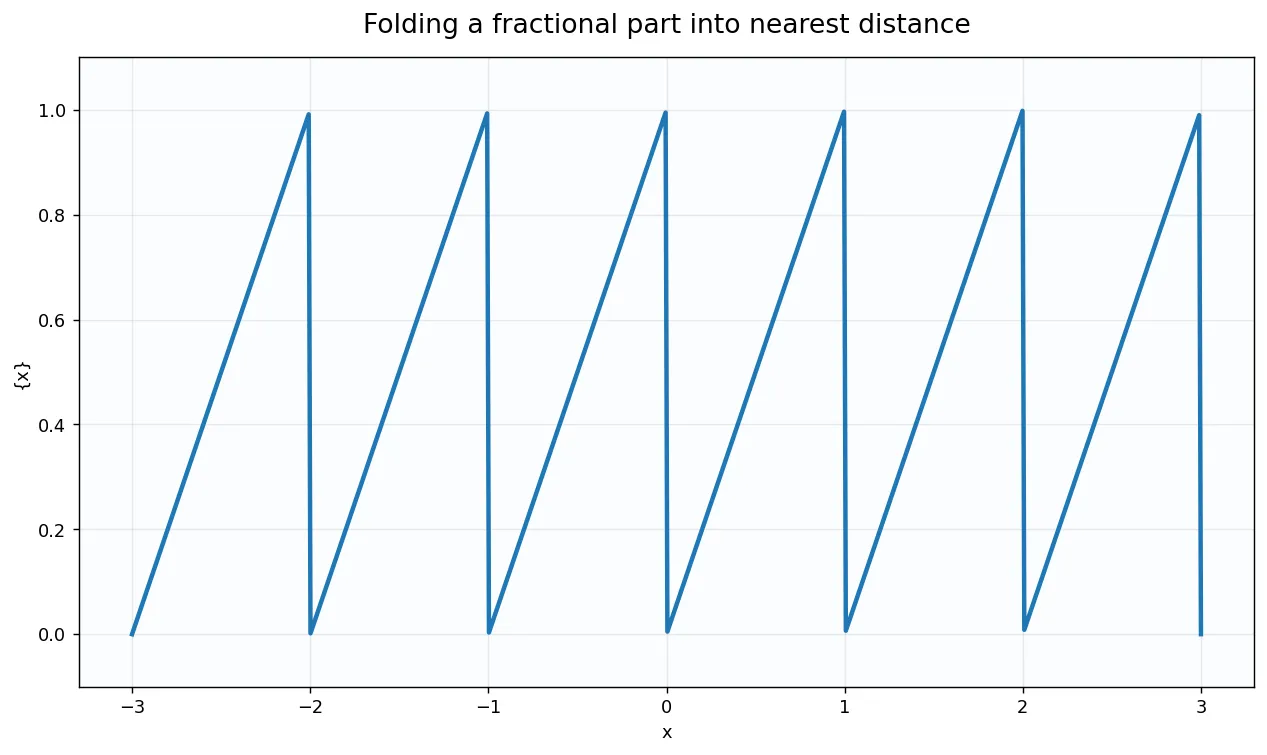
We define the fractional part mathematically as the difference between a number and its floor,
. This operation effectively strips away the integer portion, leaving only the remainder between zero and one in a sawtooth pattern.
The folding function itself is specifically defined by the expression
. This specific formulation selects the smaller value between the fractional part and its complement relative to the integer one, creating a symmetric return path.
By applying the minimum operator, the function creates a distinctive "folding" effect in the output. Instead of continuing linearly like a standard sawtooth wave, the output reverses direction at the midpoint of each integer interval, ensuring mathematical continuity throughout.
This definition serves as the core logic for generating a standard triangle wave. It transforms a simple linear progression into a bidirectional oscillation that is essential for various technical applications in discrete mathematics and modern digital signal processing algorithms.
Interpreting Distance to the Nearest Integer
The maximum distance occurs at the half-integer points, such as 0.5, 1.5, or 2.5. At these specific coordinates, the value is exactly 0.5, representing the furthest possible point from any integer value within the standard real number system.
This "nearest integer" logic ensures that the function remains strictly bounded between 0 and 0.5. It creates a symmetric path that oscillates back and forth as the input value increases steadily across the entire domain of real numbers.
Understanding this distance-based perspective allows researchers to apply the function in specialized fields like crystallography or signal quantization. It simplifies complex periodic behaviors into a straightforward measurement of proximity within a set of discrete, equally spaced target points.
Geometric and Periodic Properties
Analyzing the Continuous Triangle Waveform
The visual representation of the folding function is a continuous triangle wave. Unlike square or sawtooth waves, this waveform is characterized by its sharp peaks and valleys connected by straight linear segments that maintain a constant absolute slope value.
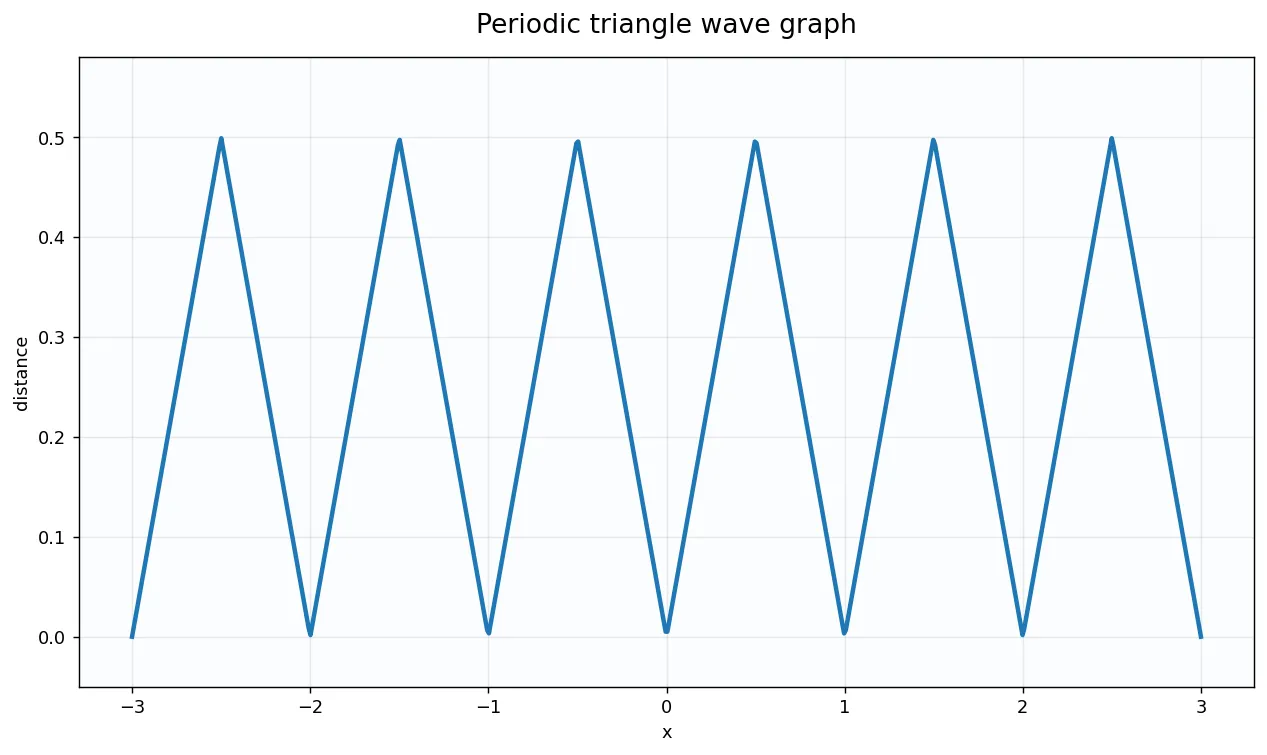
Because the function is composed of linear pieces, it is classified as a piecewise linear function. This property makes it relatively easy to calculate and implement in digital systems, software algorithms, and hardware-based function generators used in laboratories.
The resulting shape is perfectly symmetrical within each period of the wave. This symmetry is vital for applications requiring balanced oscillations, such as frequency modulation or certain types of audio synthesis found in professional electronic music production and sound design.
Peak Values and Zero Crossings
The behavior of the folding function at specific points defines its periodic character. The zero crossings occur precisely at every integer value, where the distance to the nearest integer is naturally zero, marking the start and end of cycles.
The amplitude of the wave is therefore fixed at 0.5, while the peak-to-peak value is also 0.5. This standardized range is often scaled in engineering to meet specific voltage or signal requirements for various electronic and mechanical control systems.
By observing these peaks and zeros, one can easily determine the period of the function. In its standard form, the period is exactly one, repeating its triangular pattern across the entire domain from negative to positive infinity without variation.
Analytical Expressions and Transformations
Alternative Mathematical Representations
While the minimum function is the most common definition, there are other ways to express the folding function. One popular alternative involves using the absolute value function combined with the rounding operator to achieve the same geometric result.
The expression
yields the exact same triangle wave. Here, the rounding function maps ##x## to the nearest integer, and the absolute value calculates the non-negative distance between the input and that rounded integer value.
Another representation uses the arccosine of a cosine function to generate the wave. While more complex, the formula
produces a similar periodic triangular shape through the application of circular trigonometric identities.
Fourier series can also approximate the folding function using an infinite sum of sine or cosine waves. This approach is particularly useful in physics to understand the harmonic content and spectral characteristics of the triangle wave in signal processing.
Each of these mathematical forms offers unique advantages depending on the technical context. For computational efficiency, the simple fractional part method is usually preferred, while trigonometric forms are better suited for theoretical wave analysis and frequency domain studies.
Scaling and Shifting the Waveform
results in a wave with a period of ##1/k##, enabling high-frequency oscillations for communication systems.
Vertical shifts can be achieved by adding a constant to the output, moving the entire triangle wave up or down. This is common when aligning signals with specific reference levels or DC offsets in analog and digital electronics design.
Combining these transformations allows engineers to create highly customized waveforms. These adjusted folding functions are the essential building blocks for complex signal modulation and periodic data modeling in various scientific fields, including physics, acoustics, and telecommunications.
Practical Applications in Science and Engineering
Signal Processing and Function Generators
The folding function is a staple in signal processing for generating reliable triangle waves. These waves are essential in function generators, which are used to test and calibrate electronic equipment and circuits in both industrial and research laboratory environments.
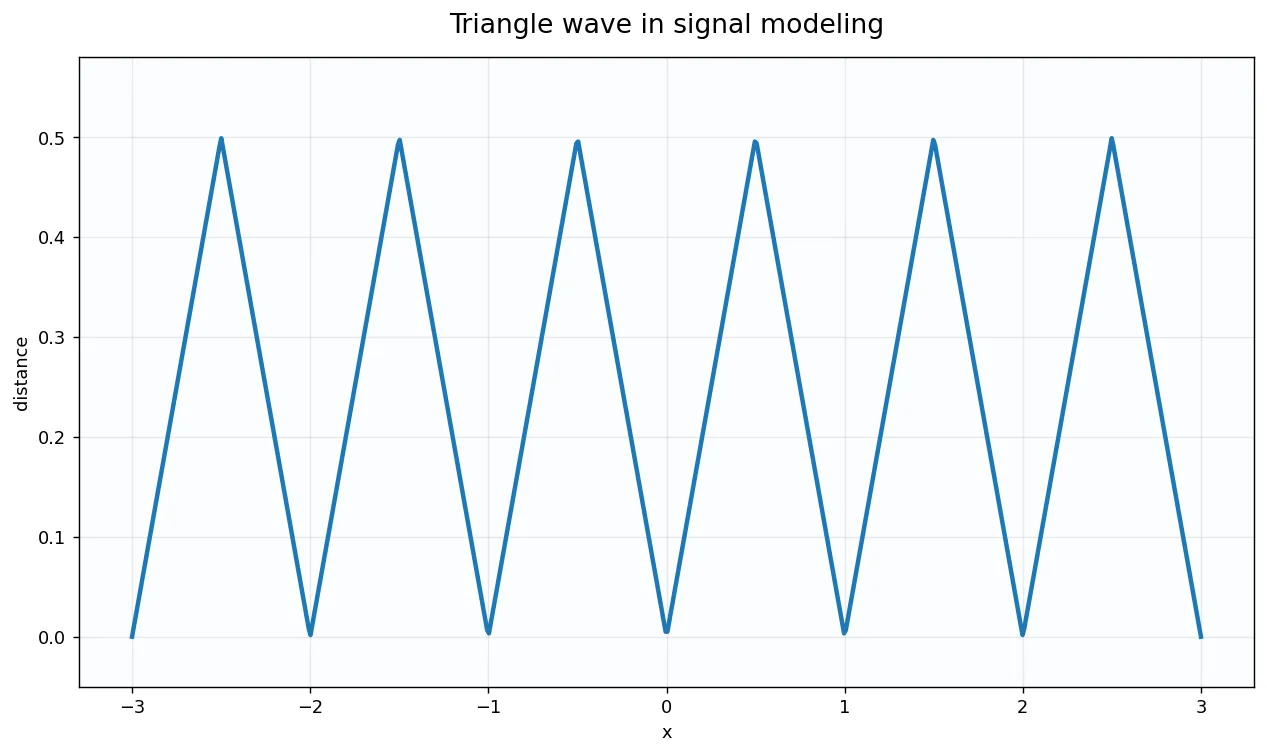
Because triangle waves have fewer high-frequency harmonics than square waves, they are often used in audio synthesis. They provide a smoother, more mellow sound that is useful for creating specific musical tones and textures in synthesizer architecture.
In Pulse Width Modulation (PWM), triangle waves serve as the carrier signals. By comparing a reference signal to the triangle wave, controllers can generate precise pulses for motor speed control and power conversion in modern electric vehicle systems.
Digital signal processors (DSPs) utilize the folding function to implement efficient periodic algorithms. Its piecewise linear nature allows for fast computation without the heavy overhead associated with calculating complex transcendental functions like sine or cosine in real-time applications.
Furthermore, the function is used in aliasing prevention and dithering techniques. By providing a predictable periodic reference, it helps maintain signal integrity during the sensitive conversion between analog and digital domains in high-fidelity audio and video recording equipment.
Modular Arithmetic and Computational Use
Beyond electronics, the folding function plays a significant role in modular arithmetic and computer science. It is used to map values into a specific range while maintaining a continuous transition at the boundaries, preventing sudden jumps in data.
In computer graphics, "mirroring" textures often employs the folding function logic. When a texture coordinate exceeds the boundary, the function "folds" it back, creating a seamless, mirrored repetition across a 3D surface without visible seams or alignment errors.
The function is also useful in hash functions and random number generation algorithms. Its ability to distribute values evenly across a range while maintaining periodicity helps in creating uniform data distributions and reducing collisions in large-scale database systems.
In optimization problems, the folding function can act as a penalty term or a distance metric. Its linear growth away from integers makes it a natural fit for constraints involving discrete values and nearest-neighbor searches in multidimensional data sets.
Overall, the folding function is a versatile tool that bridges pure mathematics and applied engineering. Its simplicity and reliability make it an indispensable component of the modern technical toolkit for scientists, engineers, and software developers working on periodic systems.
Explore More From Our Network
Understanding Inequalities in Harmonic Homogeneous Polynomials
Rat Lungworm Infection: Woman’s Burning Legs Led to Shocking Diagnosis
Can AI Predict Neuroscience Study Outcomes Better Than Humans?
The Rise of Edge-Native Agentic Silicon: Major Chipmakers Shift to ‘Autonomous-First’ Architectures
Recursive Query Blank Value: Troubleshooting Parent/Child Relationships in SQL
Tier 2 JIT Compiler Integration Achieves 40% Performance Gains in Enterprise Web Frameworks
When the right polices employee speech after viral tragedies online
Understanding the Benefits of JavaScript and Its Importance to Developers


Comments