


The Hidden Flaws of Bezel-Set Engagement Rings: A Critical Analysis
- Dec 13, 2025
- 8 min read
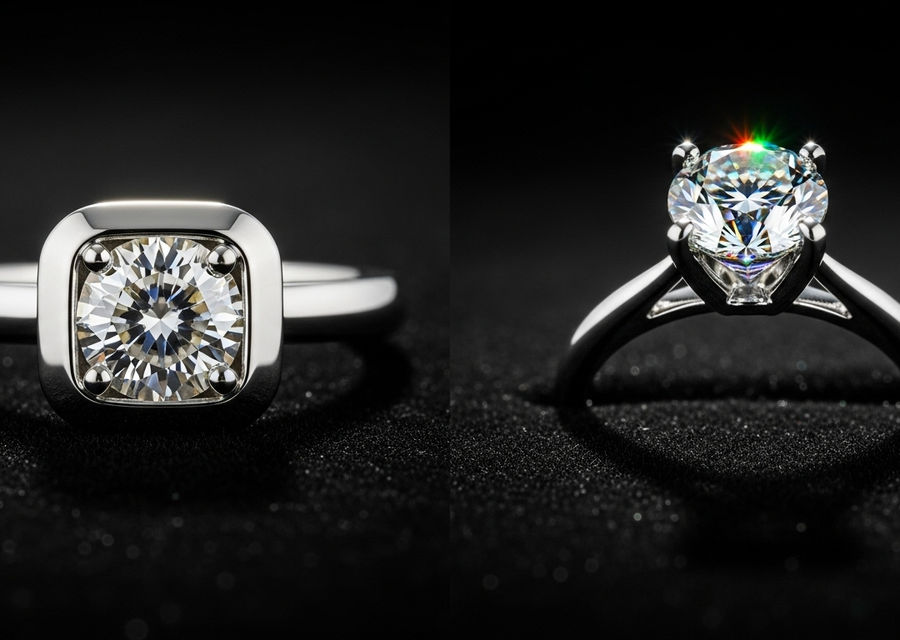
In the cyclical world of high fashion and luxury jewelry, trends often re-emerge disguised as innovations. Recent industry reports and style editorials have heavily championed the return of the bezel-set engagement ring, framing it as the ultimate choice for the modern, active, and minimalist consumer. This aesthetic—characterized by a continuous metal rim encircling the gemstone—is being lauded for its snag-free practicality and sleek silhouette. However, beneath the polished surface of these glowing endorsements lies a complex debate regarding light performance, gemological integrity, and long-term maintenance.
While the allure of minimalism is understandable in an increasingly cluttered world, the rush to adopt bezel settings represents a fundamental misunderstanding of why diamonds became the premier gemstone for bridal jewelry in the first place. By prioritizing a "protected" aesthetic, consumers may inadvertently be sacrificing the very characteristic that defines a diamond’s value: its brilliance. This analysis challenges the prevailing narrative, arguing that the bezel trend is not a step forward in design, but rather a stylistic regression that compromises the optical mechanics of fine jewelry.
The Physics of Brilliance: A Case for Light
The critical angle determines the boundary at which total internal reflection occurs. For a diamond, this is described by the equation:
Because this angle is relatively small, diamonds are incredibly efficient at trapping light and bouncing it back. However, this efficiency assumes that light is entering the stone from multiple angles, not just the table (the flat top). Prong settings elevate the stone, allowing ambient light to enter from the sides (the girdle) and the pavilion. A bezel setting, by definition, encases the entire circumference of the stone in metal. This effectively blocks a significant portion of incident light.
Gemological studies suggest that obstructing the side profile of a diamond can reduce its perceived fire (the dispersion of white light into spectral colors) and scintillation (the sparkle observed during movement). When you choose a bezel, you are essentially placing blinders on a high-performance engine. You are paying for a gem capable of handling light in complex ways, only to restrict its intake to a single vertical channel. For authoritative insights on diamond cut mechanics, resources like the Gemological Institute of America (GIA) provide extensive data on how cut grading relies on unobstructed light return.
The Illusion of Security vs. The Reality of Hygiene
One of the primary selling points for bezel settings is security. The narrative suggests that a metal rim offers superior protection against chipping compared to exposed prongs. While it is true that the girdle of the stone is covered, this structural choice introduces a insidious issue: hygiene and entrapment.
In a standard prong setting, the open architecture allows for easy cleaning. Water, soap, and ultrasonic waves can pass through the gallery, dislodging oils and debris. In contrast, a bezel setting creates a tight seal—but rarely a hermetic one. Over time, microscopic particles of lotion, soap scum, and organic debris migrate under the rim of the metal. Once trapped between the pavilion of the diamond and the metal wall, this debris is exceptionally difficult to remove without professional intervention.
This accumulation creates a dark, dull film behind the stone. Because the bezel blocks side access, you cannot simply brush it out. The result is a diamond that loses its luster not because of the cut, but because it is resting on a bed of grime. Furthermore, trapped moisture in certain metal alloys can accelerate tarnishing or skin irritation. The "active lifestyle" marketing pitch fails to mention that while the stone might not snag on your yoga pants, it will likely become a reservoir for every product you use.
Commercial Incentives: Hiding the Flaws
A critical, often unspoken aspect of the jewelry trade is how setting styles influence inventory movement. Industry insiders observe that bezel settings are frequently used as a tool to mask imperfections in gemstones. In a prong setting, the diamond is naked; inclusions near the girdle or a poor color grade are immediately visible. The stone must stand on its own merits.
A yellow gold bezel, for instance, is excellent at masking a diamond with a lower color grade (such as J, K, or L colors). The reflection of the yellow metal through the stone makes it difficult for the eye to discern the diamond's natural tint. Similarly, a bezel can hide chips or "naturals" (unpolished surfaces) located on the girdle of the stone. While this allows consumers to purchase larger stones for lower prices, it also means the setting is doing heavy lifting to elevate a sub-par product.
When high-end designers push bezel settings as "chic" and "modern," they are also conveniently promoting a design that allows for lower-grade inventory to be sold at premium "designer" margins. It shifts the value proposition from the intrinsic quality of the diamond to the "artistry" of the metalwork, a subjective metric that is harder for consumers to price-check against market standards. For market data on diamond pricing and grading, reliable indexes can be found at Rapaport.
The Repair and Resizing Nightmare
The practicality of a ring extends beyond daily wear to its long-term maintenance. Human bodies change; fingers swell with heat, pregnancy, or age. Resizing a ring is a standard procedure in the lifecycle of bridal jewelry. However, resizing a bezel-set ring is fraught with technical risks that prong settings do not share.
To resize a ring, the metal shank is typically cut and expanded or bridged. In a bezel setting, the metal rim is structurally integral to holding the stone. Altering the curvature of the band can distort the bezel cup. If the cup stretches or warps even a fraction of a millimeter, the stone becomes loose. Unlike prongs, which can be easily tightened with pliers, tightening a bezel requires hammering or burnishing the metal back over the stone.
This process applies significant pressure directly to the diamond. If the jeweler is not an expert, or if the stone has hidden internal tension features, the risk of cracking the diamond during a resize or retipping is substantially higher. Furthermore, if the bezel wears down over decades—a common occurrence as gold is a soft metal—rebuilding a bezel (re-tipping the rim) is a complex, labor-intensive, and costly job compared to simply soldering on a new prong. The "low maintenance" claim is valid only until maintenance is actually required, at which point it becomes a "high cost" reality.
Aesthetic Longevity: The Trap of the "Trend"
Fashion is transient, but engagement rings are intended to be perpetual. The current obsession with bulky, gold-heavy bezel settings aligns with the broader "chunky gold" jewelry trend of the mid-2020s. However, history teaches us that setting styles that are heavily anchored in a specific era's fashion often look dated rather than vintage in the future.
Consider the "illusion heads" of the 1940s or the massive halos of the early 2010s. Both were marketed as the pinnacle of style in their heyday. Today, they often date a ring specifically to those periods, losing the timeless appeal of a classic solitaire or a simple three-stone setting. The bezel setting, particularly the heavy, tube-like variations currently popular, risks becoming the "shag carpet" of jewelry design—a feature that future generations will look at and immediately want to remodel.
True timelessness in jewelry usually involves minimizing the metal to maximize the gem. By reversing this ratio—emphasizing the metal enclosure—we are stepping away from a design philosophy that has held true for over a century. Institutions like the Smithsonian, which houses the Hope Diamond, demonstrate that the world's most valuable gems are set with minimal interference, allowing the stone to speak for itself.
The Fallacy of the "Active Lifestyle" Argument
The strongest defense for the bezel setting is usually lifestyle-based: "I work with my hands," "I am a nurse," or "I rock climb." While valid concerns, the bezel is not the only, nor necessarily the best, solution. Low-profile prong settings, cathedral settings, and semi-bezel (or half-bezel) designs offer a middle ground that protects the stone without suffocating it.
Furthermore, the idea that a bezel ring allows one to wear fine jewelry during high-impact activities is a dangerous misconception. No fine jewelry, regardless of the setting, should be worn while lifting heavy weights or rock climbing. Gold is malleable; gripping a barbell can deform a bezel just as easily as it can bend a prong. The difference is that a bent prong is visible and easily fixed. A deformed bezel might pinch the stone or, conversely, stop holding it securely without the wearer noticing until the stone rattles or falls out.
By marketing bezels as "invincible," retailers encourage consumers to treat their fine jewelry with less care than is required, leading to preventable damage. The narrative essentially gives users permission to be negligent, under the guise of robust design.
Comparative Economics: Metal Weight vs. Stone Value
From an investment standpoint, the shift toward heavier metal settings alters the cost breakdown of the ring. Bezel settings require significantly more gold or platinum than prong settings. With precious metal prices at historical highs, a consumer choosing a bezel setting is allocating a larger percentage of their budget to the band rather than the diamond.
Let’s analyze a hypothetical budget allocation using a simplified ratio:
In a traditional solitaire, this ratio is high; you are putting your money into the liquid asset (the diamond). In a heavy bezel setting, the ratio decreases. You are paying for labor (burnishing is time-consuming) and raw material (gold weight). While gold has value, the markup on craftsmanship and retail gold pricing is rarely recoverable on the secondary market. A high-quality diamond, however, retains intrinsic market value based on the Rapaport Price List.
Therefore, by following the bezel trend, consumers are often diverting funds that could have purchased a higher clarity or carat weight stone into a perishable aesthetic preference. It is a reallocation of capital from the asset to the accessory.
The Psychological Shift: Are We Bored of Sparkle?
There is a psychological dimension to the bezel trend. It represents a shift away from "ostentatious display" toward "understated luxury." However, this cultural pivot paradoxically clashes with the product being purchased. A diamond's primary function is to refract light—to sparkle. If the goal is a matte, understated look, other gemstones or materials (like onyx, jade, or even simple metal bands) are far better suited.
Putting a diamond in a bezel is akin to buying a Ferrari and installing a speed governor to keep it under 40 mph. It signals a conflict in consumer desire: wanting the status symbol of a diamond but rejecting the visual properties that make it unique. This cognitive dissonance suggests that the trend is driven more by social signalling (fitting in with the current "clean girl" or "old money" aesthetic) than by an appreciation of the jewelry art form itself.
Alternatives for the Discerning Buyer
For those seeking security and low-profile wearability without compromising the integrity of the diamond, several alternatives exist that outperform the full bezel:
The Half-Bezel:This design holds the diamond on two sides (usually East-West or North-South) but leaves the other sides open. This allows light to flush through the stone while still protecting the girdle.
Six-Prong Settings:Often called the "Tiffany" style, six prongs offer redundancy. If one prong breaks, five remain to hold the stone, offering high security with minimal light blockage.
Flush Settings (Gypsy Set):For true minimalists, sinking the stone into the band (flush setting) offers the ultimate smooth surface. While it reduces light entry, it is honest about its intent and structure, unlike a raised bezel which mimics a solitaire but acts like a vault.
Leading design houses and auction catalogs, such as those from Sotheby's, consistently show that the highest value items historically favor minimal metal interference. The market has spoken over centuries: let the light in.
Final Perspectives: A Trend Best Approached with Caution
The resurgence of the bezel-set engagement ring is a fascinating case study in how fashion can override physics. While visually distinct and marketed as the practical choice for the modern era, the trade-offs involved—diminished brilliance, hygiene issues, repair difficulties, and the potential for masking lower-quality stones—are significant.
Jewelry is deeply personal, and aesthetic preference will always play a leading role in decision-making. However, consumers should be wary of confusing a "trend" with an "upgrade." The bezel setting is not a new technology; it is one of the oldest methods of stone setting, predating the advanced cutting technologies we have today. We moved away from it for a reason: we learned how to cut diamonds better, and we wanted to see them shine.
Before succumbing to the sleek images dominating social media feeds, buyers should ask themselves if they are purchasing a diamond for its unparalleled ability to manipulate light, or if they are purchasing a golden cage that subdues it. In the end, a diamond deserves to breathe, and the bezel setting, for all its modern hype, leaves it gasping for air.


Comments